

Practical guide: climbing at the Rocks today
Updated: October 2026 · Compiled from public sources consulted that month
The Rocks are no longer the free-access, no-rules cliff of thirty years ago: today a private nature reserve, private landowners and an organised community coexist. This is what is worth knowing before you go, compiled from public sources in October 2026 — access has changed several times, so always confirm the details at the entrance.
Access: a mosaic, with a fee in the reserve
Much of the cliff forms part of the El Turpial Nature Reserve, a Civil Society Nature Reserve declared by Resolution 148 of 2017. The reserve charges an entrance fee — meant to fund its conservation, according to its management plan — and runs a visitor registration protocol. Another part of the cliff lies outside the reserve and does not charge, although, as the study in the Revista Brasileira de Pesquisa em Turismo (2025) on the case notes, the most attractive routes are inside the fee zone.
Recent sources do not agree on a single fee: current listings put entrance to El Turpial at COP 15,000 per person (Destiplus), and reports of charges on private land run around COP 7,000–10,000 per day. Budget between COP 10,000 and 15,000 per day of climbing and confirm at the entrance. For the independent climber, no published permit or mandatory insurance was found; commercial guided activities do include an assistance policy, and the guides working today show ACGME certification.
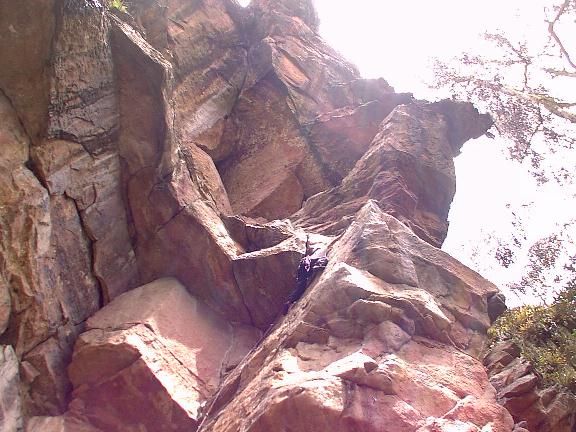
Camping and where to sleep
The marked camping zone is in front of the Mañana Gris sector: COLPARQUES lists it at about COP 20,000 per person per night, with toilets and a restaurant. Along the rail line, 5–10 minutes from the entrance, is Campo Base, the climbers' classic field (reports of COP 15,000 with shower and toilets; spacious and, at weekends, noisy). There are also private campsites and glamping along the road — Niddo Suesca among them — and the usual rule: bring your water.
At the entrance (Cacicazgo and La Playa sectors) are the climbers' hostels, such as Caminos de Suesca — with a bouldering wall, gear rental and guides — and Torre Alta. The town, about 2 km away, adds hotels and country houses for those who prefer a bed and a hot shower.
«Budget between COP 10,000 and 15,000 per day of climbing, and confirm the fee at the entrance: charges change.»
The community
The story is well known: Erwin Kraus climbed here around 1938; in the 1970s came Gonzalo Ospina and Alberto Castro; in 1984 Daniel Anker equipped "Nueva Era", the first sport route, and in the 90s the Valle de los Halcones was opened. Today the meeting point is still the entrance: the MonoDedo shop — the same one from the classic online guide — sells the printed guidebook, rents gear and resolves the beta of the moment, and the local schools (Suescalada, El Refugio, Colombia Oculta, among others) offer courses and guided outings with insurance included.
For studying routes: Grace Andrea Montoya's printed guidebook (3rd ed., 2007) remains the historical reference; Rockbooks published a guide by Rodrigo Arias in 2021; and online there are theCrag and Mountain Project, with hundreds of routes logged by the community. The Mayor's Office leads the municipality's tourism and in 2026 called cleanup days at the Rocks with local providers: the community also takes part in looking after it.
Rules, closures and care
Valle de los Halcones. Its ~50 routes are on entirely private land, with documented access problems. Ask the owners' permission or coordinate the visit through Suesca's Tourist Information Point; camping is prohibited there.
Bolting. The classic guidebook's ethic still holds: consult experienced local climbers before opening or re-equipping, do not remove other people's protection, and remember that on sandstone fixed gear can loosen — check anchors and bolts before trusting them with your life.
Heritage. The cliff keeps Muisca pictographs in at least ten sectors mapped by the Mayor's Office. Do not touch them or chalk them.
No published closures. No nesting closure in force in 2024–2026 was found; even so, if you see active nests, move away and report it at the entrance.
Leave No Trace. Rubbish comes back with you or goes in the bins at the entrance; do not pull native vegetation — the "beards" and bromeliads of the wall take years to grow. And a standing warning: the railway line is active. The rail line is the access and also a working train line; stay alert, always.
Practical facts
- Routes: more than 400 documented (some sources say more than 500), from 5.6 to 5.13c, on a cliff 2–3 km long with walls of 20 to 130 m and multi-pitches of up to 4–5 pitches. About half is sport and half traditional or mixed. A 60 m rope covers almost everything.
- Old-school style: the grades are stiff, the first bolts sit high and there are exposed stretches. Bring nuts even if you come for sport, and a helmet, always.
- Climate: at ~2,600 m above sea level, the typical day runs from 6 to 18 °C, with cold, windy nights. Climbing is year-round; the driest spells are usually December–February and June–August, and the wettest March–May and October–November.
- Getting there: bus from Portal del Norte in Bogotá (~1 hour), getting off at the "entrance to the Rocks". The full detail is in Getting there.
Compiled in October 2026 from public sources: COLPARQUES, Detour Cundinamarca (Governor's Office), Destiplus, MonoDedo, theCrag and Revista Brasileira de Pesquisa em Turismo (2025). Fees and charges are indicative and change: confirm at the entrance before you travel.